There is no single “golf flag.” A sponsor flag lining a charity scramble, a pin flag that lives on a course all season, a 6-inch flag on a backyard putting green, and a signed keepsake destined for a frame are four different orders with four different right answers. Buy the wrong combination of size, sides, fabric, and attachment and the flag either looks lost on the stick, fades by midsummer, or will not fit your flagsticks at all. Here is how to match the spec to the job.
Match the size to where it flies
Size is set by distance and viewing, not preference. A regulation course pin flag runs about 14 by 20 inches and rides a full-height flagstick around 7.5 feet, so it reads from across a fairway. A putting green or practice flag is far smaller, roughly 6 by 8 inches on a 5-foot pin, sized for short sightlines and backyard or indoor greens. A driving range flag goes the other way at about 18 by 25 inches so a target stays visible at 150-plus yards. Order the size for the sightline, and remember that a flag that looks big on your desk can disappear at range distance.
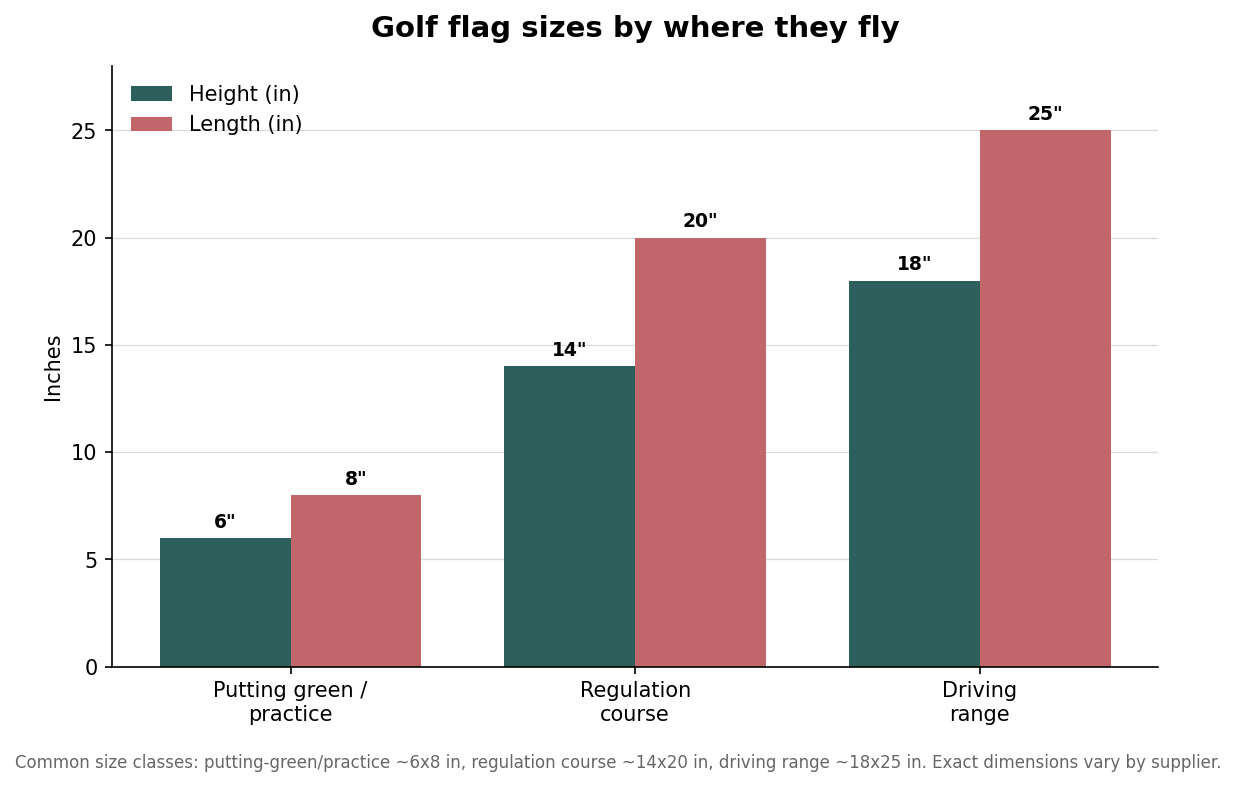
If the flags are decorative markers for a tournament, sponsor recognition rather than play, you have more freedom, but keeping to the regulation 14-by-20 footprint means they also fit standard course hardware afterward.
Single-sided or double-sided: decide by how it is seen
This is the choice buyers most often get wrong. A single-sided (single-reverse) flag is printed once on a lighter, more open fabric so the image bleeds through and appears mirrored on the back. It is the economical, standard build and it is fine when viewers mostly see one face, or when a mirrored logo does not matter. A double-sided flag is two printed panels sewn together around an inner blockout liner, so both faces read correctly with no show-through, on a heavier, nearly opaque cloth. That construction costs more and weighs more, but it is what you want when a sponsor logo will be photographed from both sides or the flag hangs where traffic passes on either hand. As a rule, single-reverse for play and general use, double-sided when both faces are on display and the brand has to read the same way from either side.
Pick the fabric for weather and wear
Fabric decides how long the flag survives. Heavy 400-denier nylon is the durable, wind-tolerant choice built for a full season of daily play on an exposed course. Lighter 200-denier nylon flies more easily in gentle wind and offers a wider stock color range, which suits solid-color and low-wind settings. For full-color logos, photos, and gradients, dye-sublimated polyester is the method that infuses ink into the fabric for fade-resistant, photo-quality print; the print cloth comes lighter and more translucent for single-reverse work (on the order of 3.25 ounces per square yard) or heavier and opaque for double-sided builds (around 6.10 ounces per square yard). Match the cloth to exposure: a one-day tournament can use a lighter flag, but anything living outdoors for months earns the heavier nylon or a robust sublimated polyester.
Confirm the attachment before you order
A flag that will not mount is a common and avoidable mistake. The most widespread system is a pole pocket with a hollow tube: the sleeve slides over the flagstick and a tube and cap hold it in place, which fits most standard course and practice sticks. The alternative is a grommet-and-heading flag that attaches with clips or ties, used on some flagsticks and display poles. Before ordering, check which system your existing flagsticks use, because a tube-pocket flag will not clip to a grommet stick and vice versa. If you are buying flags and sticks together, either style works; if you are adding flags to hardware you already own, let the hardware decide.
Handle sponsor and keepsake flags on their own terms
Two use cases sit outside normal play and deserve their own thinking. Sponsor and hole flags at a charity or corporate outing are read up close and photographed for recap emails and social posts, so they reward a double-sided build, a clean full-color sublimated logo, and enough contrast to hold up in a phone photo taken in bright sun. Keep the logo large and the background simple; fine text and thin lines that look right on a proof can vanish on cloth flapping in the wind. Commemorative and signed flags are a different animal, because the flag becomes a keepsake rather than course hardware. Here a heavier, opaque fabric takes a signature better and looks right behind glass, and a lighter background leaves room for the autograph. If the plan is to frame it, order the flag at the size your frame or shadow box expects and confirm the flag lies flat rather than curling at the pocket.
Plan the timeline around the event
Custom flags are printed to order, so lead time is part of the spec. At Get Custom Golf Flags standard production and delivery takes about 2 weeks from the moment you approve the mockup, which itself arrives within 24 hours. Build in extra room for artwork proofing and for the reality that tournaments cluster in season, when print queues get long. For a dated event, tell the supplier the date up front and start early enough to approve a proof, fix a color, and still receive the flags with days to spare.
Put the pieces together and the decision is quick: size for the sightline, sides for how it is viewed, fabric for how long it lives outdoors, attachment for the sticks you own, and timeline for the date on the calendar. Get those five right and the flag does its one job, which is to look sharp on the stick when it matters.