Two custom golf flags can carry the same logo and cost twice as different amounts, fly completely differently in wind, and last one season or three, all because of choices buyers rarely see on a product page: the fabric, how the two sides are built, and the print method. If you are ordering pin flags in bulk for a course, an event, or a sponsor package, understanding those three material decisions is what keeps a good-looking proof from becoming a faded, curling flag by the second summer. Here is what each one actually does.
Sizes and the flagstick they hang on
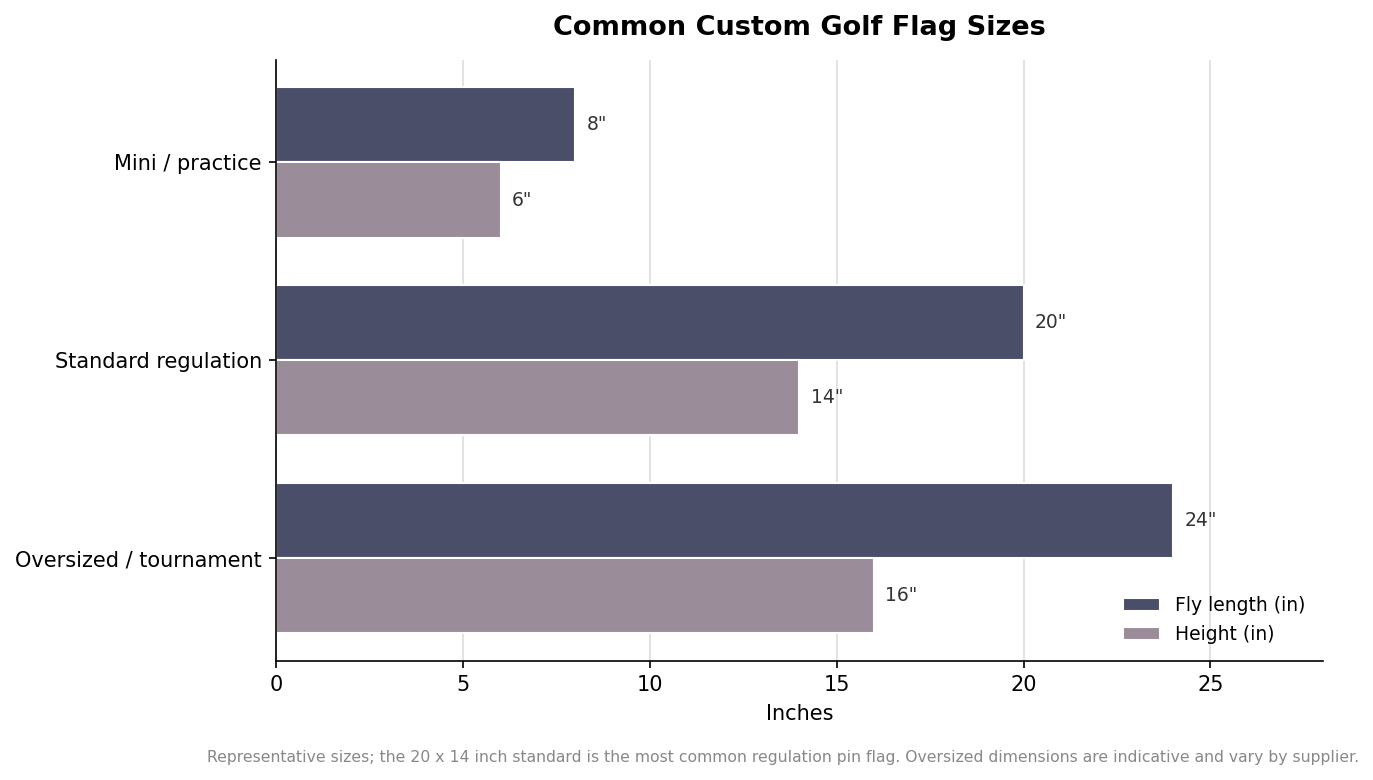
The standard regulation pin flag is 20 inches on the fly by 14 inches tall. That size fits the seven-foot flagstick used on most courses and is what players expect on a green. Practice-green and giveaway flags are commonly smaller, around 8 by 6 inches, which keeps them cheap for high-volume handouts and tidy on a backyard putting green. Some events order oversized flags in the 24-by-16-inch range to read from farther away or to stand out on a signature hole. Whatever the size, the flag has to match the flagstick it will hang on, so confirm the pole diameter, usually about half an inch, before you order the attachment.
Size is the easy part because the choices are few and standard. The decisions that follow, fabric and construction, are where flags quietly succeed or fail.
The fabric decides everything downstream
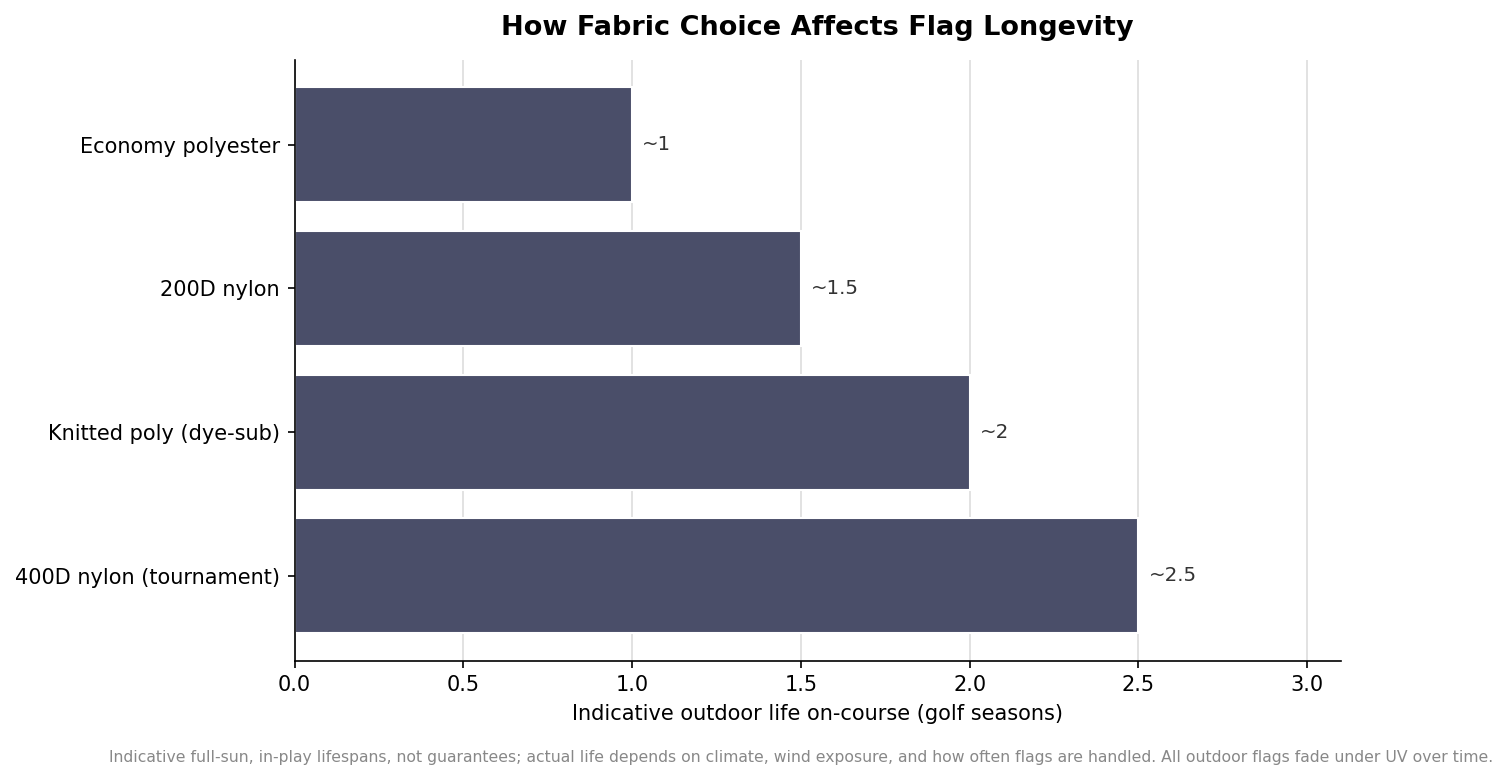
Fabric sets weight, flapping behavior, print quality, and lifespan all at once. Nylon is the traditional course fabric: it is light, flies and furls easily in a breeze, and holds solid dyed or screen-printed colors well. It comes in weights measured in denier, with 200-denier nylon as the economical everyday choice and 400-denier and heavier reserved for tournament flags that need to survive constant wind. Knitted polyester is the other main option, and it is the canvas of choice for full-color, photographic, or gradient artwork because it takes dye sublimation cleanly.
Heavier fabric lasts longer but flies less freely, so there is a real trade-off between longevity and how lively the flag looks on a calm day. For a course that replaces flags on a schedule anyway, a lighter nylon may be the better value; for a permanent installation or a harsh, windy site, the heavier weight pays for itself. The chart later in this guide shows how fabric choice shifts the expected outdoor life.
How the two sides are built
Double-sided is not a single thing, and the version you pick affects both cost and readability. The most common and economical build is called single-reverse: the flag is printed on one side and the ink bleeds through the lightweight fabric so the design appears in mirror image on the back. It flies well because it is a single layer, and for a simple logo the reversed back is perfectly acceptable. True double-sided construction sews two printed panels together with a light-blocking layer in between, so each face shows a correct, fully opaque image, and you can even run a different design on each side.
The practical rule is that single-reverse is right for logos and text that read fine mirrored, while true double-sided is worth the added cost when the back must read correctly, when you want two designs, or when the flag hangs where both faces are seen up close. Deciding this before you get a proof avoids the common surprise of a backwards logo on the reverse. For a side-by-side look at the two builds, see our double-sided vs. single-sided golf flags comparison.
Printing: dye sublimation versus screen print
The print method follows from the fabric and the artwork. Dye sublimation embeds the dye directly into polyester fibers, which produces photo-quality, full-color, high-definition images with a soft finish and no raised ink to crack. It is the only realistic way to reproduce gradients, photographs, or many-colored crests, and on lightweight knit it is what makes the single-reverse effect possible. Screen printing instead pushes opaque ink onto the surface of nylon, one screen per color, which is excellent for bold, solid, one- or two-color logos and stands up well outdoors, but it is impractical for full-color art.
For most custom course and event flags with a detailed logo, dye-sublimated polyester is the default. For a simple bold mark on classic nylon, screen printing is a durable, cost-effective classic. Match the method to the complexity of your artwork rather than the other way around, and remember that every outdoor flag fades under ultraviolet light eventually; better fabric and quality dyes slow it, they do not stop it.
Attachment, finishing, and how to order
Attachment and edge finishing are the details that decide day-to-day durability. A rotating pin tube, a hard sleeve that spins around the flagstick, sheds wind and reduces furling, which is why it is the popular course choice; two brass grommets are the alternative where a course hooks flags onto a fixture. Double-sewn or double-stitched edges and a reinforced heading resist the fraying that kills a flag from the corners inward, so they are worth specifying on anything meant to stay out for a full season. When you place the order, put the whole spec on one line: size, fabric and weight, single-reverse or true double-sided, print method, attachment, and quantity. Then ask for a proof that shows both faces, and order a buffer if the flags are tied to an event date, because a reprint on custom flags restarts the production clock.